

You’ve got this pain in your heel, especially first thing in the morning, that just won’t go away.
What’s causing it?
You have Plantar Fasciitis!
Plantar Fasciitis is damage and inflammation of the fascia in your heel – that’s what the -it is part means. Research is mixed for what is going on in the heel, but, it starts with inflammation and if unchecked progresses to fascia tissue damage, with longer term cases moving to heel spurs.
But, for most of you, Plantar Fasciitis means pain on the inside bottom part of your heel and can radiate up your arch or outside of your foot. Pain tends to be most severe first thing in the morning or after periods of rest like sitting at a desk.
You could be reading this and think mine get worse as the day goes on, its more painful in the evening or in bed, don’t worry 80% of cases are post rest, 20% react differently!
Why does it hurt? It tends to start and get progressively worse with time and use if not managed or addressed. The research and my experience suggest it starts with inflammation and if unchecked progresses to fascia tissue damage, with longer term cases moving to heel spurs.
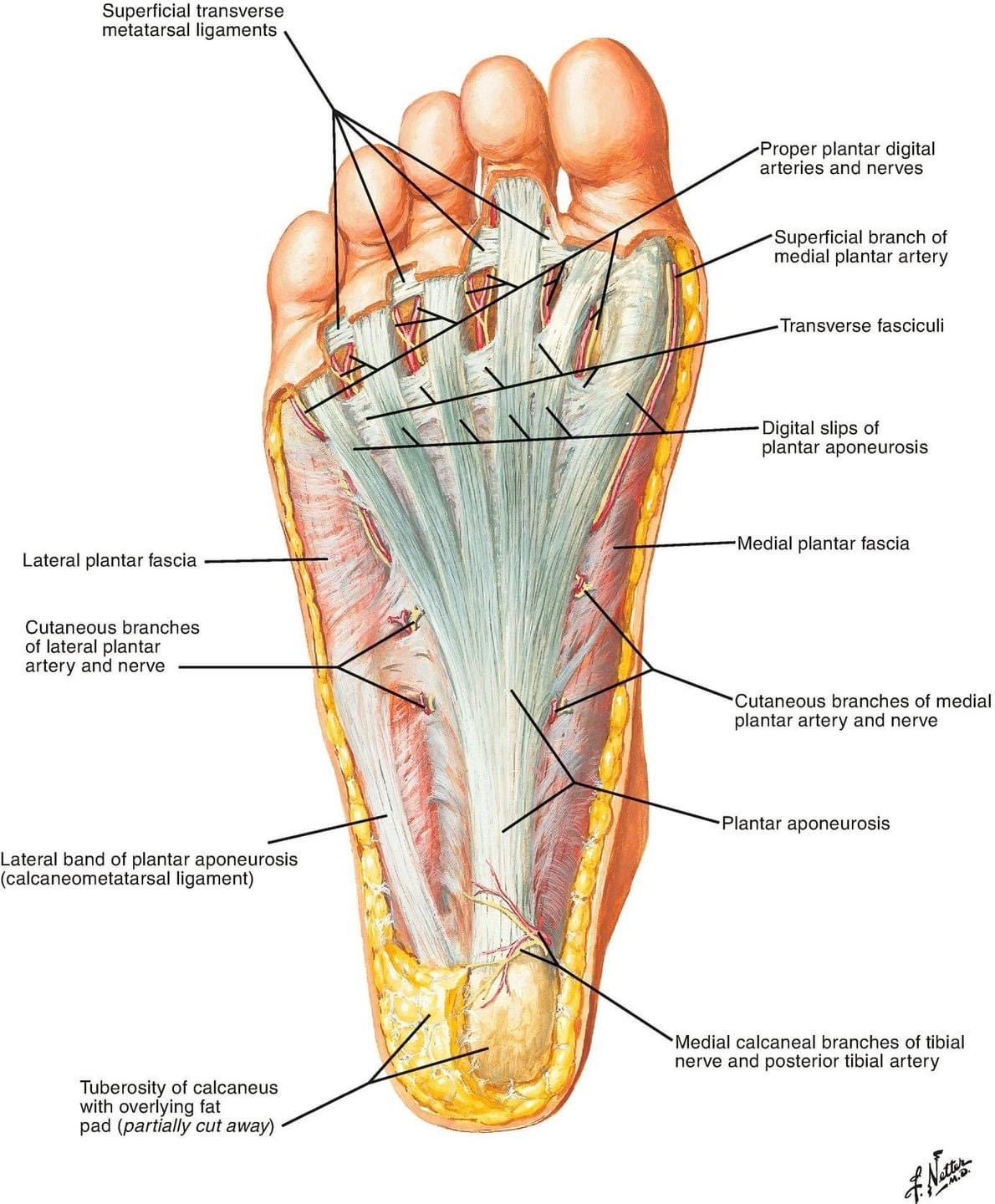
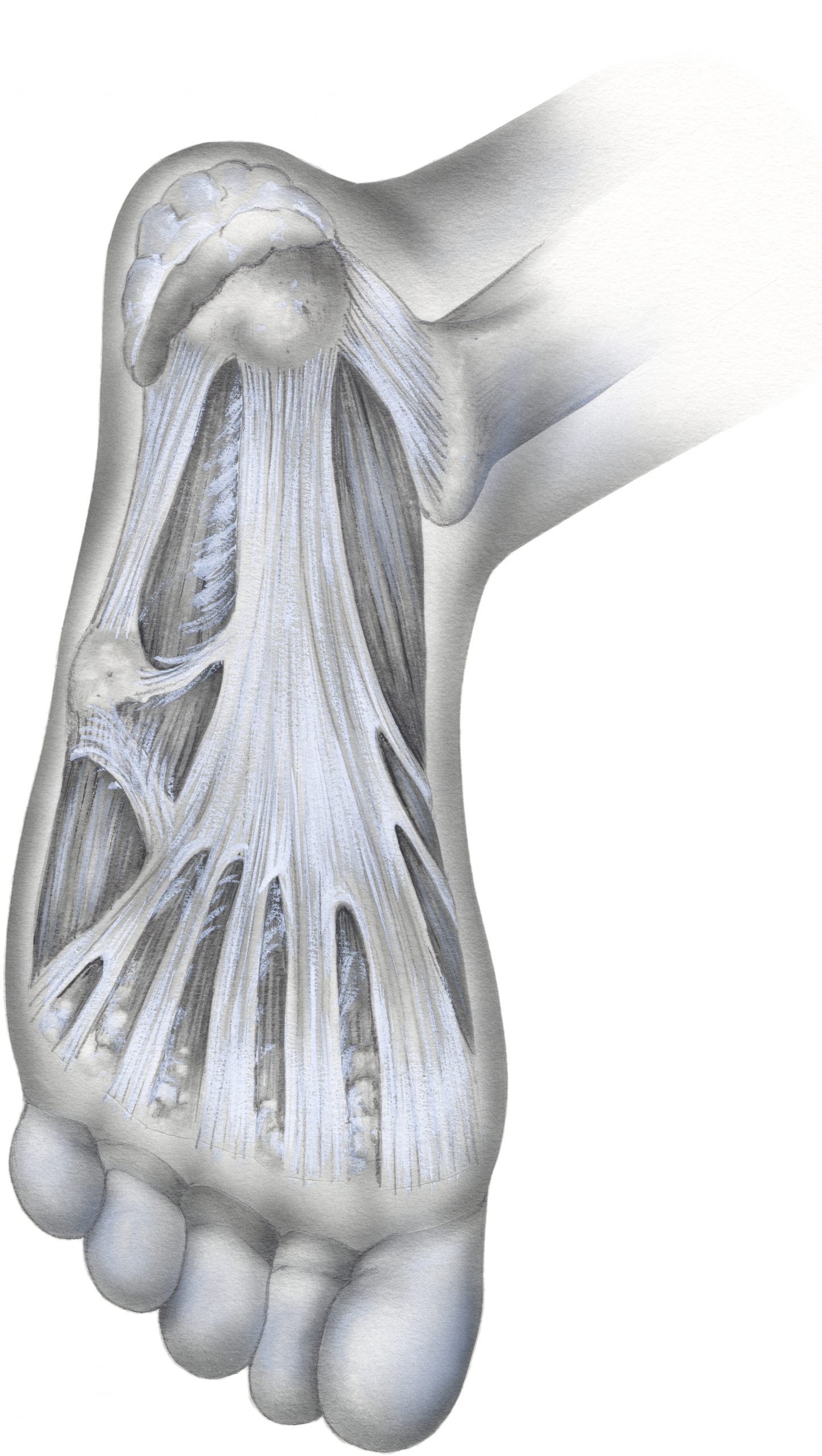
So what is your Plantar Fascia?
The Plantar Fascia is a flat band of dense connective tissue that connects your heel bone to your toes. Plantar is the anatomical term for the sole of your foot; fascia is the anatomical term for the band. It starts at the heel and connects to the ball of the foot and supports toes. The Plantar fascia is similar to tendons (which connect muscle to bone) and ligaments (which connect bone to bone), it’s function is to support the arch of the foot and keep it structurally stable.
The foot is a complex thing and the structural stability of your foot comes primarily all the pieces fit tightly together. The bones, the ligaments, the tendons, and the muscles all provide shape and support, but, the plantar fascia has the greatest effect on overall foot integrity. If your plantar fascia is cut, you lose 25% of your foot stability (Huang et al. 1993).
The main functions of your plantar fascia from research (Kirby 2016).
- Supports the medial (inside) and lateral (outside) longitudinal arches of your foot – it gives them shape and structure.
- Aids in making your foot more efficient when you go to push off as you take a step.
- Assists the lower leg muscles by eliminating movement at the foot and assists the deep muscles in your foot in preventing arch flattening.
- Reduces forces on the ligaments on the bottom part of your foot.
- Prevents excessive compression on the joints in the top of your foot.
- Prevents excessive bending stress on the metatarsals (toe bones).
- Allows you to keep your toes on the ground and helps stabilise your toes.
- Reduces forces on the small bones at the ball of your foot on the bottom.
- Helps to absorb and release elastic energy during running and jumping activities.
Wow that’s a lot!
Some of the above is critical to recovery time and damage repair.
To summarise, The Plantar Fascia provides a strong mechanical linkage between the heel and the toes. It starts at the heel and fans out to run across the sole of your foot in 3 major bands, like a hand spreading out. The bands vary in size and thickness in everyone depending on how you walk and move and the activities you do.
As most people walk more on the outside of their foot, they put more pressure on the inside or arch of the foot, meaning pain and damage tend to be in the middle of the foot moving to the arch (Wearing et al. 2006).
90% or more of people with plantar fasciitis experience pain in the heel!
The connective tissue in the heel bone ranges in strength from really, really stiff to soft connective tissue. This is split into 4 zones and allows for shock absorption when the heel hits the ground and structural support in different directions to resist movement when doing activity or sports.
This is really important as the activity or movement position of the foot tends to be why you have plantar fasciitis. Direction and force put pressure on the connective tissue and unless you have strong feet the muscles cannot take the load so your fascia becomes inflamed and damaged.